
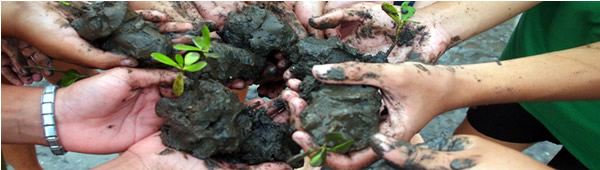
"Planting Mangrove for Life, It's Fun."
Beyond Illegal Logging: Understanding Charcoal Production and Conserving Biodiversity in the Philippines
Every trip back from the mountains of Negros Island left me with the same striking image. The jeepney descending from the forest was piled high with sacks of charcoal. By the time it reached downtown, passengers' faces were covered with black dust. I began asking a simple question: Where was all this charcoal coming from?
That question led to one of the first comprehensive surveys of charcoal production inside the North Negros Natural Park in the Philippines.
The remaining natural forest of Negros Island now covers only about 4% of its original extent, yet it is home to many endemic and endangered species. At the same time, charcoal remains one of the few reliable income sources for upland communities. Conservation policies often portray charcoal producers as drivers of illegal logging, but little empirical evidence has existed on how charcoal production actually affects forests or why households continue the practice.
Our research interviewed 169 charcoal-producing households, representing nearly one-third of all households in the study area. The findings challenged several common assumptions.
First, charcoal production is not a large commercial enterprise. Most families operate only one or two charcoal kilns using family labor. More than 80% of households earn less than 10,000 Philippine pesos per month, and charcoal provides 60?80% of household income. Simply prohibiting charcoal production would therefore remove the principal livelihood of many families without providing viable alternatives.
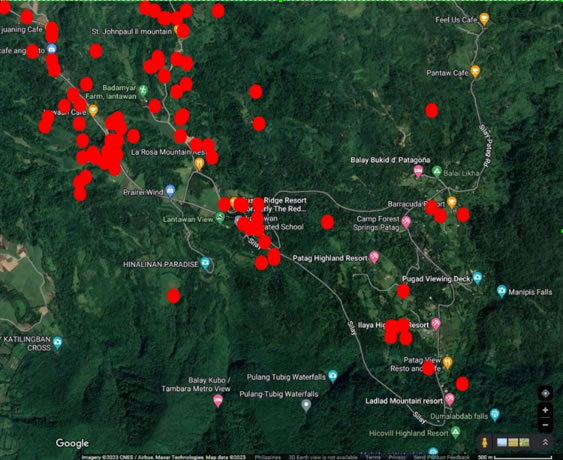
Second, combining household survey data with estimates of forest biomass revealed that charcoal production accounts for approximately 3.8% of the forest's annual biomass growth. While this figure suggests that overall biomass loss is relatively limited, the problem lies elsewhere. Charcoal production creates numerous small clearings that remain unreplanted for many years, fragmenting forest habitat and threatening biodiversity. Satellite imagery clearly shows these expanding gaps across the protected area.
The study demonstrates that forest conservation should not focus solely on law enforcement. Instead, sustainable forest management must combine scientific evidence with community participation. Based on the findings, we proposed a package of practical measures including reforestation around charcoal sites, environmental education, alternative livelihood development through agroforestry and ecotourism, and continuous monitoring using satellite imagery and drones.
Perhaps the most important lesson is that charcoal producers are not simply perpetrators of deforestation. They are also potential partners in forest restoration. Many interviewees expressed a willingness to reduce or eventually leave charcoal production if realistic alternatives became available.
Development practitioners frequently encounter situations where poverty and environmental degradation are closely intertwined. This project illustrates how evidence-based research can move the discussion beyond blame and toward collaborative solutions that protect both biodiversity and rural livelihoods.
As the Philippines and many other tropical countries work toward the goals of the Global Biodiversity Framework, understanding the people who depend on forests may be just as important as protecting the forests themselves.
This study forms the basis of a new community-based initiative that integrates biodiversity conservation, sustainable charcoal production, and participatory forest management in North Negros Natural Park.
コンタクト
129 Sampaguita Ext, Fortuna Subdivision, Silay City, Negros Occidental, Philippines 6116
+63-34-495-0231
ikawako.assist@gmail.com